By Jaime Ulloa Gómez, Fondecyt N°1250016 Researcher
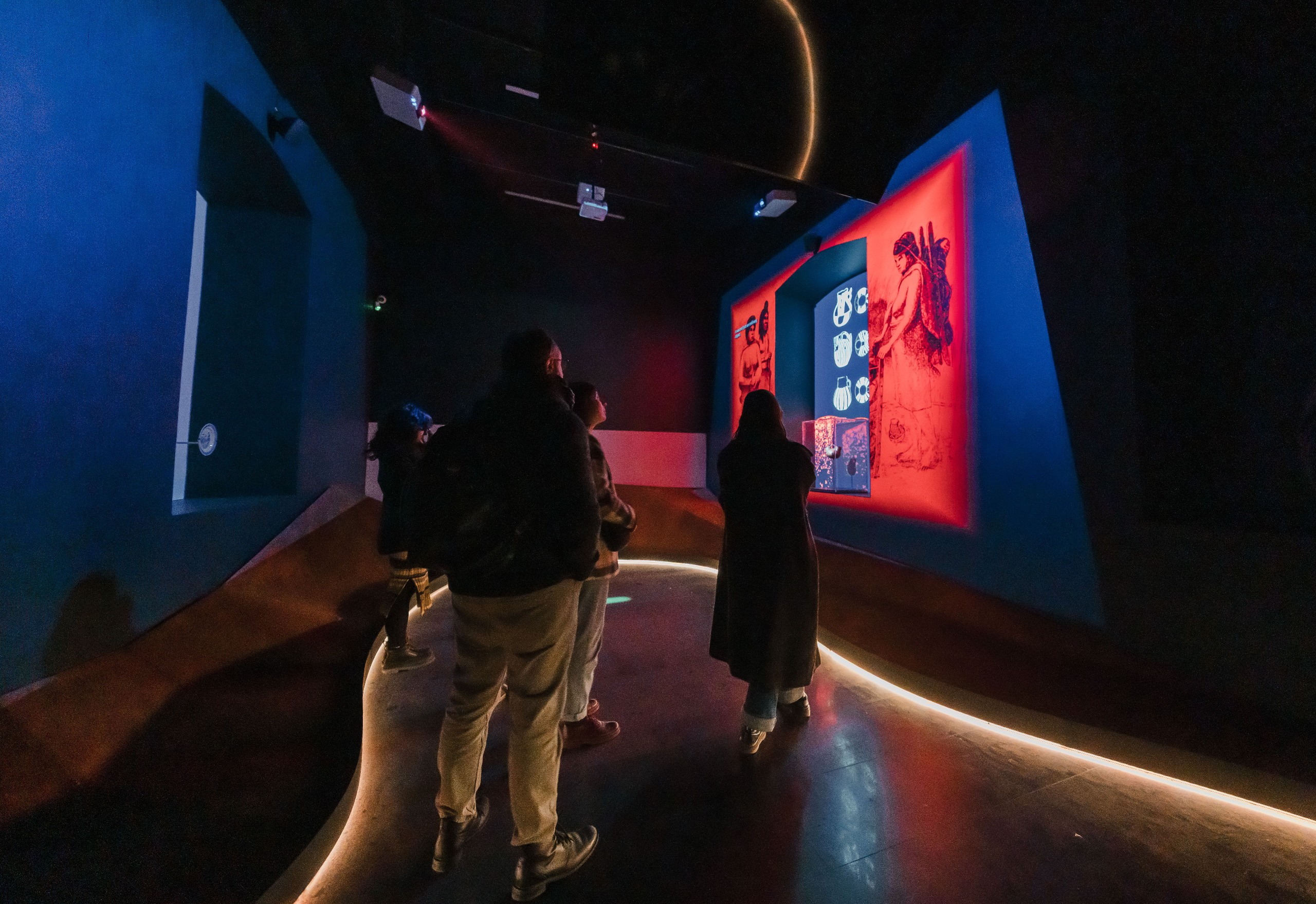
What do a Pitrén vessel, a Willow plate produced in Penco (Chile), and a digital screen have in common? What changes when we stop thinking of AI as a “cloud” and begin to see it as a profoundly earthly entity?
Those were the questions that greeted priest and philosopher Paolo Benanti at the Chilean Museum of Pre-Columbian Art during his visit to the recently inaugurated exhibition Bajo nuestros pies: las tierras raras de la IA [Below Our Feet: The Rare Earths of AI], created by Martín Tironi and Manuela Garretón.
Benanti is a Franciscan priest, professor of moral theology at the Pontifical Gregorian University, and one of the Vatican’s and the UN’s leading advisors on artificial intelligence. His work has focused on the ethical, political, and anthropological implications of digital technologies. The friar was visiting Chile in the context of the launch of the AI Node of the Pontifical Catholic University, a space that seeks to articulate reflection and collaboration around AI.
Making the most of his visit, Benanti toured the Chilean Museum of Pre-Columbian Art alongside the creators of the exhibition. From that tour, a conversation began about the ethical, material, and planetary challenges of artificial intelligence, the exchange of which we present below.
Grounding the Algorithm into Planetary Infrastructures
The exhibition Bajo Nuestros Pies challenges dominant discourses about AI as a merely techno-computational matter, and takes us to the earth from which the materials that make it possible are extracted. In this way, it reveals part of the material reality of AI, surrounded by various basal conflicts and controversies, as has been observed in the social movements opposing the installation of a rare earth mine in Penco. If the call from Penco in relation to AI is to protect the land, the call from the Vatican is to protect the human person. In this spirit, the encyclical letter Magnifica Humanitas by Pope Leo XIV is presented, published just a few weeks before the opening of the exhibition. Leo XIV calls for “disarming AI”1 so that economic and geopolitical logic does not use it as a tool to oppress human dignity. Father Benanti shares this view, as can be seen in his deep critique of the theological-political ideology of techno-oligarch Peter Thiel and the “PayPal mafia.”
Both approaches to artificial intelligence converge on a shared concern: planetary habitability. More than an exclusively algorithmic question, AI poses the challenge of rethinking how we inhabit the world in the digital age and of assuming the responsibility of building, in the words of Francis — cited by Leo XIV2 — a “pluriform harmony” that includes not only human beings, but also the Earth and the multiple forms of life that sustain it.
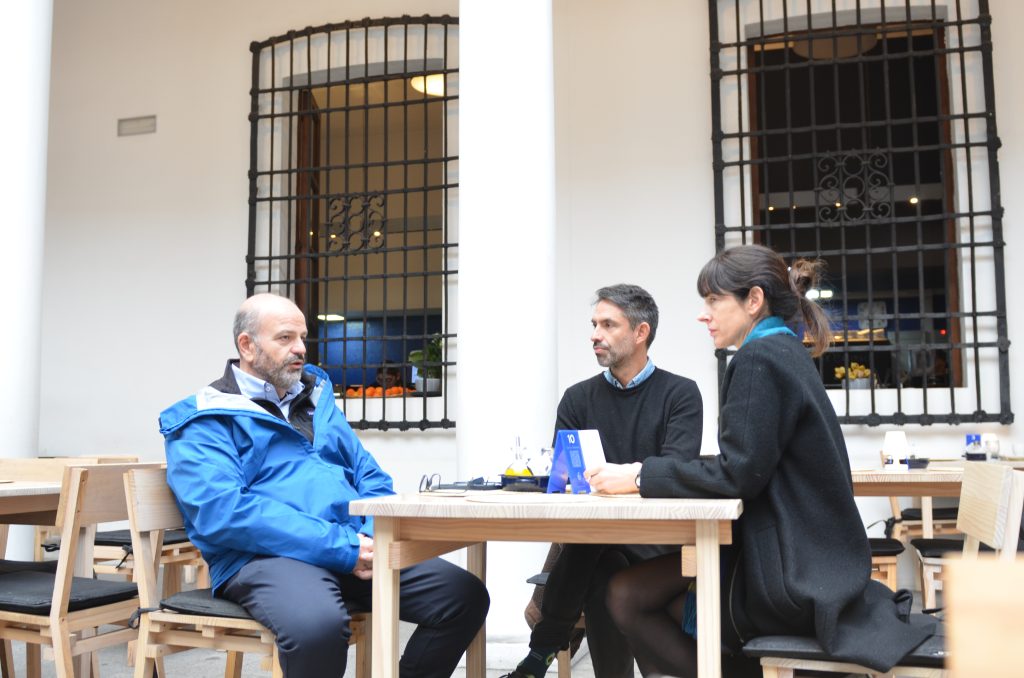
From this idea, Martín Tironi poses a question to Benanti that guides the dialogue.
MT: The exhibition emphasizes the need to understand artificial intelligence from its material and planetary anchors, while Magnifica Humanitas proposes an ethical horizon centered on human dignity and responsibility. How do these two perspectives speak to each other? Can the humanization of artificial intelligence also be thought of as a responsibility toward the Earth and toward the ecological conditions that make life possible?
PB: Well, you know, when we say AI today in the public sphere, we say something that people usually understand as the polished nice experience of an interface of an LLM that starts from 2022. This is not AI -this is not the only form of AI- but for the majority of people this is what does it mean when you say AI. And so what is a polished neutral immaterial experience actually hides a long process as a mystery of idea, a mystery of transformation and also a mystery of power of the human beings and the human beings around the globe. So every time that I’m prompting an LLM actually I’m also using a lot of underpaid jobs of the Global South to mark the data and to make such kind of data workable for the machine. But much more, the machine is also the result of a deep and profound chain of power of extraction from the earth of special minerals that allow the semiconductors to build a huge amount of quantity to work as a logical gate and as a logical capacity of the machine. But the everyday experience of a polished flat surface that is the case of AI is hidden in all what is behind it. Probably there is something similar in the recent history when we discovered that diamonds are blood-bathed, that there is a chain behind what we have in our hands that is not visible but that makes every user responsible of that chain.
And coming back to the real materiality of AI, the material AI is something that is necessary also to activate a process of responsibility inside the using of AI among the contemporary world. Because we have the tendency to think that the AI is costless or cheap. Actually AI costs a lot of energy, costs a lot of water, costs a lot of telecommunication, costs a huge transformation of a lot of area of the planets that in that case are driven by economics and economical extraction. So focusing on the material side of AI is something that can activate a process of responsibility and a chain of responsibility that is pending on the user and globally on the leaders to say if we can accept such kind of exploitation in a global justice sense or in a you know in a perspective that allow us to talk about justice and equal use of resources.
Toward Techno-Diversity. Is Another AI Possible?
MT: Today the development of artificial intelligence seems to be concentrated in a small group of large companies that define its rhythms, infrastructures, and priorities. In that context, is it possible to imagine and build other forms of artificial intelligence, more responsible toward people, territories, and the environment? Or are we facing a technological path that presents itself as singular and inevitable, where only critique and regulation remain, but not the possibility of developing alternatives?
PB: Well, to be quite frank, AI has a huge acceleration in the last 10 years and this huge acceleration not by a university driven perspective, but it happened by a market driven perspective. It happened with a huge amount of investment. Just this year, 2026, only the four first companies for capitalization in the market (Meta, AWS, Microsoft and Google) invested 650 billion in cash in AI. So if this it is the pace of investment, the predatory effect of AI is a need of such kind of race and if you add that there is also geopolitical and power shift race because we discover AI as a really powerful tool, but a really powerful weapon, well this makes really difficult to think a different approach in this landscape.
If this is the AI, so when I say “this”, I mean this way to develop, build and deploy. We already accepted the milieu in this which is happening, we already accepted this “only one will win, winner takes all” model, there is a deeply competition and not really high space for justice and fairness. As this one to be the model, I don’t know, this is a real question that is questioning different disciplines, question for example economics, is this a boom or a bubble?, is questioning social scientists, is this something that will remain compatible with the democratic regime or will transform such kind of machine in a machine to control people and granularly have a mass control system? or is something that can happen in a different way? The speed is highest, the highest speed that we see in any human process, the pressure is super high, but if this is the model, it’s really difficult to find an adjustment. I don’t think that such kind of model can run forever without causing a war or something like that.
So finding an alternative could be a way to build peace, could be a way to produce an alternative that is also a constraint of the domination desire of some players that now are really active in the market because there is also a new thing here that some of the biggest players and the few hands that are now controlling AI are not neutral in itself but are also ideologically oriented to something that would like to highlight that democracy was a failed experiment for us. So, this is the secondary element that we cannot ignore in this moment because it’s not just a matter of AI in itself but it’s also a matter of the horizon of people that is building AI, in which AI is something that has to surrogate what we call democracy in the relationship among us.
As a philosopher, I am deeply moved by Hannah Arendt’s reflection on how democracy can fail to the point of making Nazism possible. Her answer to that question was the idea of the “banality of evil”3: the recognition that the greatest atrocities can arise not only from deliberate malice, but also from the renunciation of critical thinking and the assumption of one’s own responsibility.
But if we replace deliberation and democratic function with algorithms, we risk facing a new form of banality: the banality of the algorithm. And this is no less dangerous, because algorithms respond to a single authority and do not generate, by themselves, resistance or friction. Even the most obedient human being within a regime can experience doubts, scruples, or moral conflicts that lead them to question an order; an algorithm, by contrast, lacks that capacity for ethical interruption.
This is not something that can be resolved from within such a system. As Hegel said in the Science of Logic4, there comes a moment when quantity is transformed into quality. And I believe we find ourselves precisely at that threshold today: we can see clearly what we are leaving behind, but we have not yet fully grasped what we are taking in. That is why this is a moment to slow down and reflect. It is also a moment in which universities and academia have a fundamental responsibility: to remind the actors of our time that there are conquests of humanity achieved with enormous effort — and even with much bloodshed — that cannot be discarded without running the risk of repeating the darkest pages of our history. I would not want to sound dramatic, but the speed of the transformations we are living through can profoundly alter some of the principles that have given shape to our civilization. Change is not, in itself, a value judgment: what is different is not necessarily better or worse — it is simply different. Nevertheless, speed is the enemy of discernment, and without the time needed for reflection we risk losing precisely what we need to preserve.
MT: It is interesting that you mentioned the notion of friction, because in our work it has become a central concept. We understand it as a way of introducing slowness, attention, air, and resistance in the face of the speed and apparent fluidity with which the development of artificial intelligence is usually imagined. By making visible the materialities, infrastructures, and territories that sustain it, friction forces us to stop and recognize what normally remains hidden. In that sense, friction is not an obstacle but a condition for critically rethinking an increasingly automated system. And I think that, from a Latin American perspective, thinking from friction is especially relevant: it is a way of starting from the territories, inequalities, ecologies, and concrete histories that make AI possible, rather than assuming the illusion of a universal, homogeneous technology without material anchors.
Final Reflections
After the exchange, we asked the friar for his impressions of the Bajo Nuestros Pies installation:
PB: The exhibition touched me a lot because it’s a deep clear perspective on technology and what does it mean technology in the human nature and for the human nature. I find it especially suggestive that the entire journey begins with an object as simple as a decorated plate. A tool like that not only fulfills a practical function: it is capable of transmitting a culture, expressing a way of life, and becoming a vehicle of shared meanings. Now the same clay is needed to transform another form of culture, that is the culture embedded in LLM. So every time that we make something with clay, we are not simply shaping a tool, we are embodying a culture inside the tool. And the culture become effective in shaping other people’s culture.
And so this is what we face now with AI and this is what we need to remember and to have really clear. So there is not such things as a neutral technology and there is not such things as a neutral use of resources. Every time that we use resources we are applying an implicit anthropology that say what is much more urgent and important for the human being. That, for me, is the great contribution of this exhibition. It reminds us that all technology is traversed by cultural, ethical, and material decisions, and makes visible a dimension that is indispensable for the contemporary debate on artificial intelligence.
With this reflection, the dialogue concludes between two perspectives that, from different but convergent traditions, invite us to look at artificial intelligence with a critical spirit and a sense of responsibility. Both remind us that the technological future cannot be built from uncritical fascination, but from discernment, attention to its material implications, and a commitment to a shared planetary habitability.
It is worth emphasizing the stress placed on ceasing to think of technologies as neutral entities. This is especially valid in the case of AI, whose milieu of expectations, sociotechnical imaginaries, economic stakes, and geopolitical disputes means it is partially connected to an infinite number of dimensions in the face of which we have an obligation to think critically.
Perhaps the principal lesson this exhibition leaves us with, in tune with Magnifica Humanitas -the most sophisticated screen and an ancient ceramic jug share the same earthly condition. Before being algorithms, data, or artificial intelligence, technology is clay, minerals, water, energy, labor, and forms of life. Remembering this is not a gesture of nostalgia, but an invitation to broaden our ethical and political imagination in order to think of an artificial intelligence capable of inhabiting the Earth responsibly and of recognizing the multiple relationships that make its existence possible.
With this reflection, we leave open the invitation to explore further the work and proposals of these three scholars, and especially to visit Bajo nuestros pies: las tierras raras de la IA, on display at the Chilean Museum of Pre-Columbian Art until August 16.
More about Paolo Benanti
Father Paolo Benanti is a priest ordained in the Third Order Regular of Saint Francis, professor of moral theology at the Pontifical Gregorian University — where he earned his doctorate in moral theology in 2012 — and papal advisor on AI since the pontificate of Francis I. In that role, he was appointed an ordinary member of the Pontifical Academy for Life in 2021. He is the author of several books exploring technology in the contemporary era, including Digital Era: Theory of an Epoch Change. Person, Family and Society (2020), The Great Invention. Language as Technology, from Cave Painting to GPT-3 (2021), and Human in the Loop. Human Decisions and Artificial Intelligence (2022).